Private journal on your phone
How Feelink works
Choose what to record, explore changes over time and consider a close person’s perspective. Keep control of your journal and reports.
Feelink in action
Choose a step to see a screen with sample data.
Moments and summaries
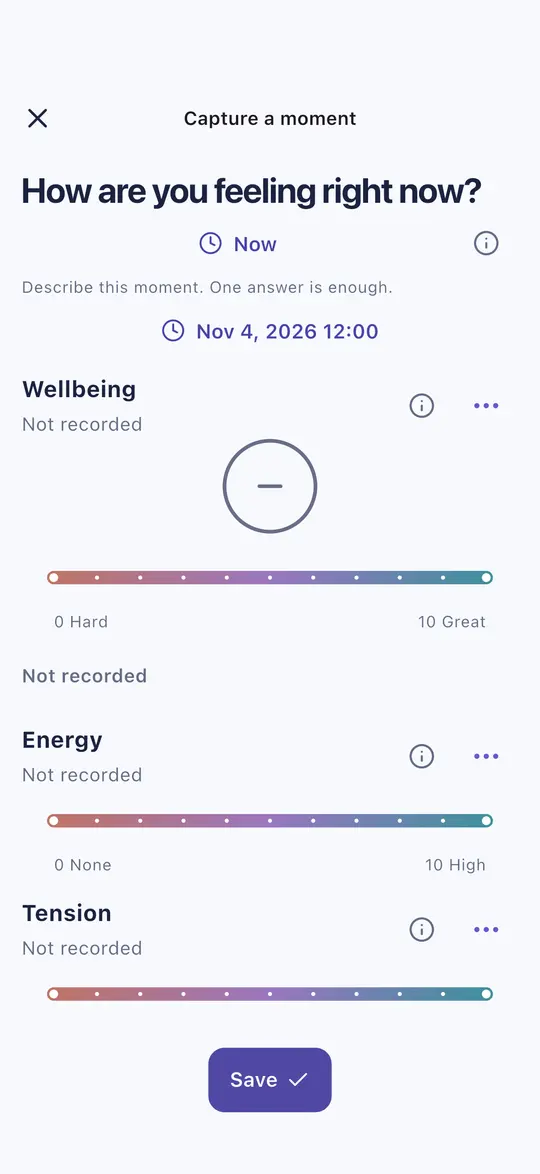
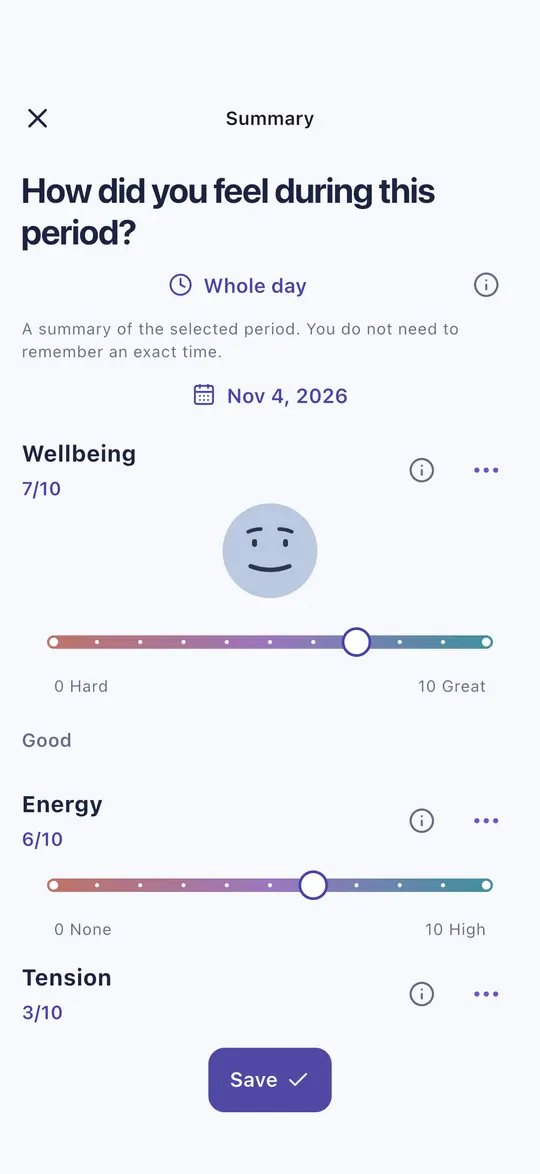
Record what is happening now or reflect on a chosen part of the day. One answer is enough; fields, context and a note are your choice.
- Make the form yours
- Choose fields and groups in Settings. Adjust starting sets to your needs.
- Preserve the meaning of time
- Now is a specific moment. Morning, daytime, evening and whole day describe a recalled period without inventing an observation time.
History
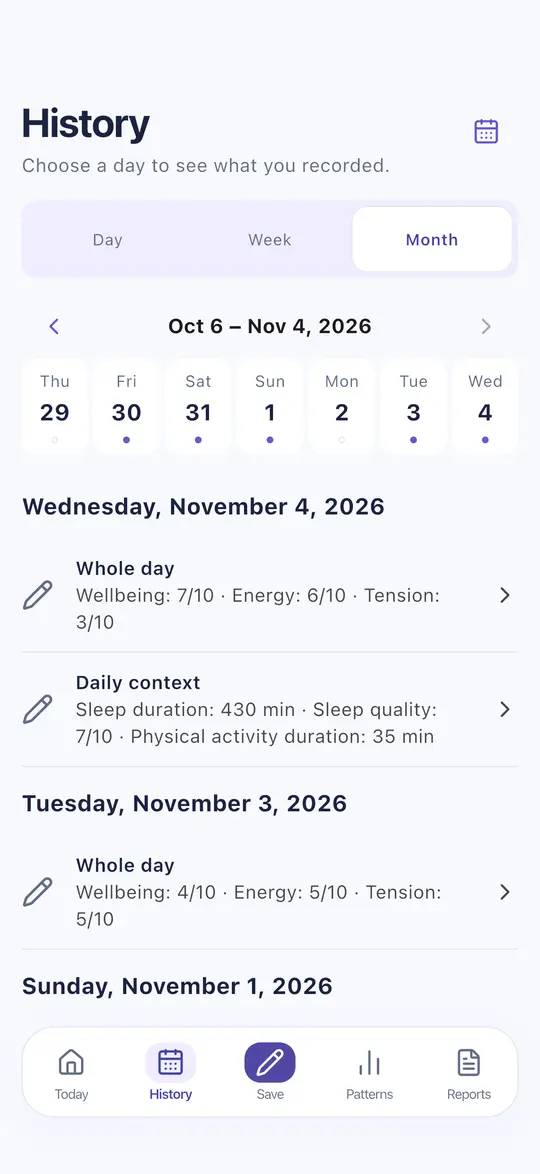
Browse day, week or month views. Return to a particular observation, its context and earlier versions.
- Details of a day
- Alongside self-ratings, review sleep, activity or other selected fields. The scope and source of each entry remain visible.
- Earlier entries and corrections
- Add an entry for an earlier day or correct a record. The correction history lets you see what changed.
Patterns
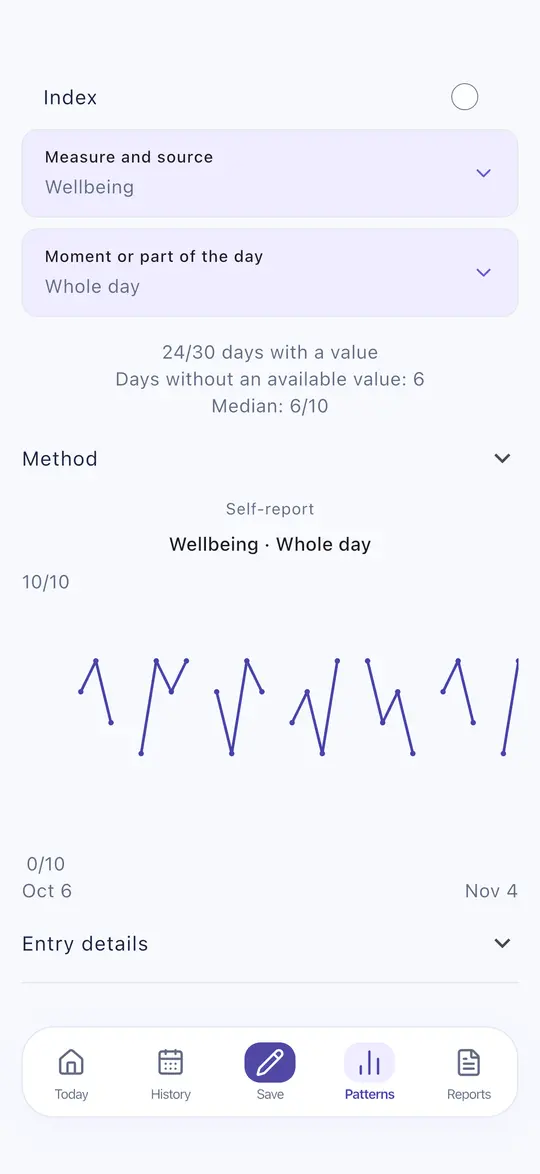
Choose 7, 30 or 90 days and a measure. Entries from the current form can be viewed separately as moments, part-day summaries or whole-day summaries.
- See the data and its gaps
- The chart, day count and summary describe the selected source. An unanswered field does not become zero or a default value.
- Explore possible relationships
- Available comparisons use defined sources and require compatible data. Occurrence together does not establish a cause. Not every new field can be used in a correlation pair.
The example shows 24 days with a whole-day summary in a 30-day period.
Changes over time and the Feelink Index
Choose what you want to explore. Patterns show recorded values, their distribution and summaries appropriate to the available source. Counts and gaps help you see how much of the period you actually recorded. Different times and entry types retain their meaning.
The Feelink Index is a descriptive summary of mood, energy, functioning and reversed tension on a 0-10 scale. It requires all four compatible self-ratings according to its method. An incomplete set stays a gap. The index is not a health assessment or a norm for comparing people. Look at its components too.
Comparisons of two observations and imported measurements use defined sources, time alignment and requirements for complete pairs. A coefficient is not shown when there is insufficient data. New form fields have their own series; we do not promise correlations for every possible pair. Similar changes may suggest a question, but do not establish a cause.
A report with selected information
Choose the dates and PDF contents, including separate selections for notes, treatment, new fields and close-person observations. Preview before saving or sharing. Reports are generated locally. The exported PDF opens without a password and can be kept outside the app.
One form, your choice of areas
Start with mood or choose more detail: energy, tension, everyday functioning, focus or sensory load. Sleep, activity, habits and your own measurements can add context.
Starting sets help you choose fields, and you can change them. Questions are optional. Add an earlier observation, return to a draft or correct an existing entry.
Treatment as optional context
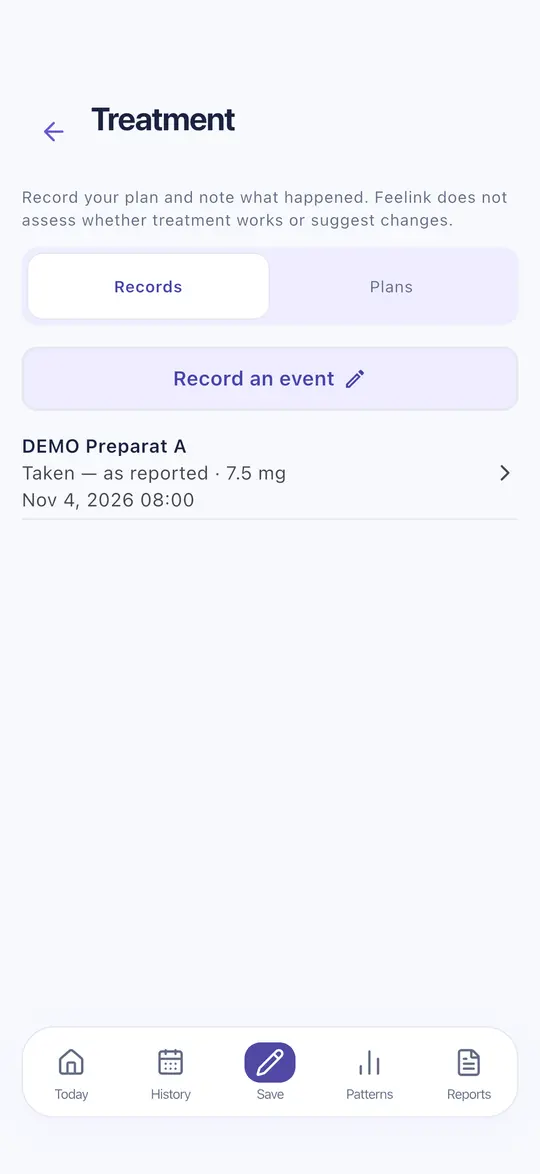
If useful, enable the treatment journal. Record your own plan, product name, dose and times. Record actual intake separately with its time and dose; you can also note a skipped, unknown or unconfirmed intake.
The history preserves plan changes and record corrections. A plan does not confirm intake. These records help you recall events, but Feelink does not assess treatment effectiveness or recommend dose changes.
Close-person observations
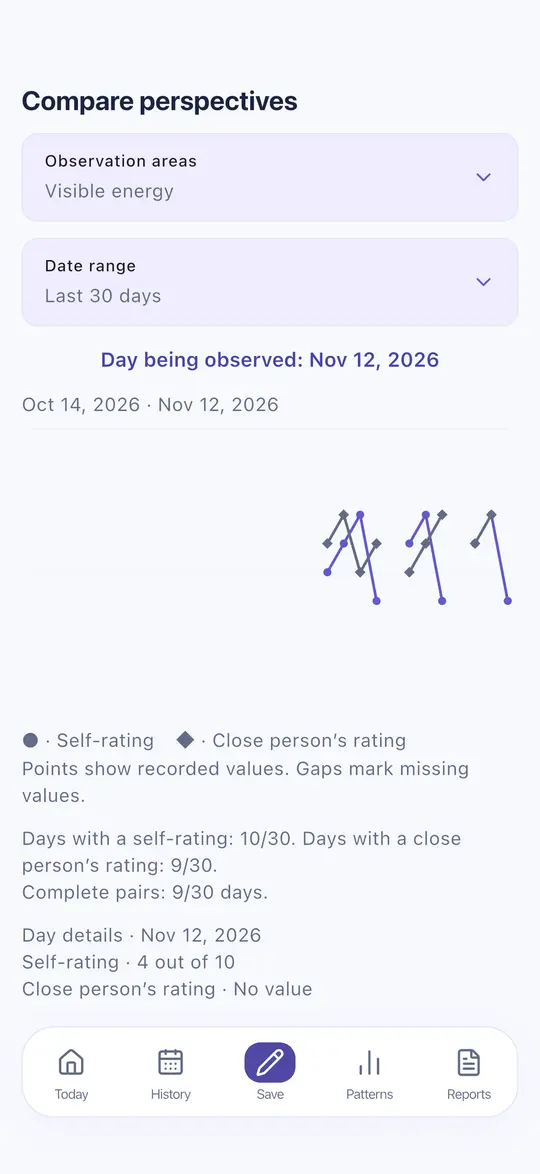
In Settings, add someone close using an alias, choose a day and hand over your phone for a voluntary form. They answer based on what they could observe: visible energy, tension and everyday activities. They can skip a scale or say they cannot assess it.
The rest of the journal stays locked during the form. Returning requires system authentication. Someone who knows the phone code or has enrolled biometrics can pass the same check.
The comparison keeps separate points and gaps for both perspectives over 7, 30 or 90 days. It is an additional perspective, not an objective verdict on how you feel. In this version, comparison self-ratings come from the earlier daily check-in type; new summaries remain a separate series. You can separately include selected close-person observations in a PDF.